

by Robert Hill
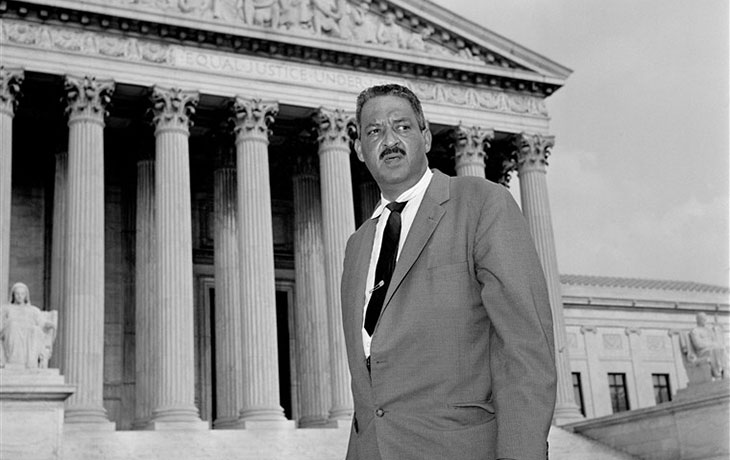
In the month of July, nearly 120 years ago, Thurgood Marshall was born. He went on to become the first African American to serve on the U.S. Supreme Court, as many of us know. The second Black member on the Court is the currently serving Clarence Thomas, as we all know.
The two high-ranking Black male Supreme Court associate justices reflect polar opposites in judicial thinking and judicial decisions. Whereas Thurgood Marshall devoted his professional life to advancing an aggressive civil rights agenda, Clarence Thomas seems bent on unraveling it.
Ironically, both grew up victimized in the Jim Crow racially segregated southern United States. Ultimately, the impact that reality had on each seems to have informed both their approaches to issuing legal opinions and, for that matter, informed their outlook on life.
Thurgood Marshall was born in Baltimore, Maryland shortly after the turn of the 20th century in 1908.
The gifted student came to Pennsylvania to study at Lincoln University outside of Philadelphia. He graduated with honors from that Black college, one of the nation’s first.
ROBERT HILL
Inspired by his father to go to law school, Thurgood Marshall was forbidden from attending the officially Jim Crow racially segregated University of Maryland School of Law in his home state.
But, Thurgood Marshall’s school-teacher mother pawned her wedding and engagement rings to pay for the young man to attend law school at the African American Howard University in nearby Washington D. C. Mrs. Norma Marshall also rented out a room to the future great African American Pennsylvania legislator young K. Leroy Irvis, as the upstate New Yorker began his teaching career in Baltimore.
Thurgood Marshall graduated from Howard Law School in 1933. He finished first in his class.
The brainiac moved to the Baltimore branch of the National Association for the Advancement of Colored People (NAACP.) With the NAACP, Thurgood Marshall experienced great satisfaction from his legal victory in Murray vs. Pearson, gaining admission to the very law school that had denied Thurgood Marshall admission—for Black applicant Donald Murray.
Thurgood Marshall successfully argued more U.S. Supreme Court cases with a win rate greater than any attorney in history, prevailing in 29 of 32 cases, nearly 91 percent of them.
Most famously, Thurgood Marshall and his NAACP team won the Supreme Court Brown vs. the Board of Education of Topeka, Kansas decision that outlawed racial segregation in the nation’s public schools.
Thirteen years after that 1954 triumph, Thurgood Marshall, was himself a member of the U.S. Supreme Court. He often dissented from the Court’s rulings, keeping faith with the cause of justice that led to his appointment to the Court.
Pittsburghers might like to know that their then-state legislator, the aforementioned K. Leroy Irvis, was denied service at Harrisburg’s Moose Lodge No. 107 restaurant, which did not serve Blacks. When the Irvis lawsuit in the matter reached the Supreme Court Thurgood Marshall was there, and Mr. Irvis lost.
Dissenting, Mr. Justice Marshall found that the Moose Lodge discrimination violated the 14th Amendment to the U.S. Constitution and sided with K. Leroy Irvis in 1972. In 1977 K. Leroy Irvis became Speaker of the Pennsylvania House of Representatives by unanimous vote. (In 1764 slaveholder Benjamin Franklin was elected to the same office, also unanimously.)
On January 24,1993, at age 84, Thurgood Marshall died. President George H. W. Bush “replaced’’ him with Clarence Thomas.
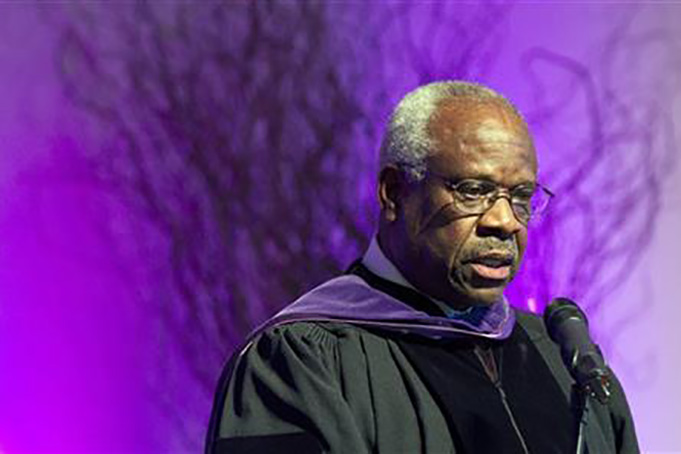
Clarence Thomas was born in the Deep South on January 23, 1948, in Pin Point, Georgia. Raised by his Catholic grandfather, Clarence Thomas prepared for the priesthood. The honor student instead quit Conception Seminary College because of racial bigotry.
In 1968 the Geechee from Georgia enrolled as a sophomore at the College of the Holy Cross, a Catholic school where he was among a few Black students. He was a founder of the Black Student Union there.
The maw of campus protests and dissension helped to convert Clarence Thomas, whose judicial opinions today are to the right of the most right-wing Supreme Court justices.
Along the way, graduating from Holy Cross with cum laude honors in 1971, Clarence Thomas was admitted to the law schools at both Harvard and Yale universities. Clarence Thomas graduated from Yale Law School in 1974 as an “excellent student’’, according to Professor Guido Calabresi.
Whether self-hate or some other inexplicable force(s) impels the positions he takes on the most profound legal issues of our era, Clarence Thomas appears to be no friend of justice, and a few facts must be taken into account in evaluating what he says and does.
In the televised Senate Judiciary Committee hearing on his Supreme Court nomination Clarence Thomas forcefully denied sworn allegations by law professor Anita Hill that he sexually harassed her at work.
He bellowed to the world, “…This is a high tech lynching for uppity Blacks who in any way deign to think for themselves…’’
As an associate Supreme Court justice, Clarence Thomas told a New York Times reporter that his Geechee-Gullah Georgia background rendered him uncomfortable speaking publicly around White people, U.S. News reported in 2016.
Although it is doubtful that the perquisites of high office, the advancement of his right-wing-agenda and the enjoyment of his ill-gotten gains could have been made possible without his Yale Law enrollment, he despises his Yale degree as an Affirmative Action degree.
Thurgood Marshall is an American hero. Clarence Thomas replaced him. But Clarence Thomas, you’re no Thurgood Marshall.
(Robert Hill is an award-winning Pittsburgh writer and communications consultant)