
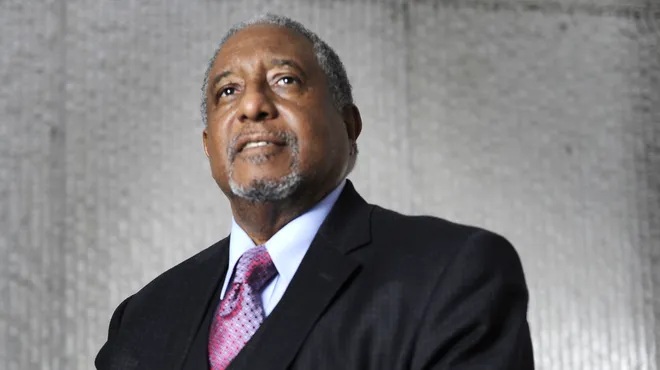

Nashville Civil rights organizer Bernard LaFayette is in Tuskegee, Alabama, on Jan. 9, 2013, to present a two-day seminar on “Kingian nonviolence” to local teachers, school administrators and police officers.
George Walker / The Tennessean
He helped desegregate downtown Nashville, pushed forward voting rights in Selma and spread a gospel of nonviolence from Chicago to South Africa, all while remaining humble and accessible.
by Tacuma Roeback, The Tennessean
Bernard Lafayette did write these words: “The value of life lies not in longevity, but in what people do to give it significance.”
But his own life epitomized significance and longevity.
Lafayette passed away from a heart attack on Thursday, March 5. But what this pioneering civil rights activist, organizer, Baptist minister and educator embodied was a singular commitment to the fight for freedom — a man with a marathoner’s endurance in tackling social justice and inequality across decades and geographies.
When activism becomes a way of life
As persistent as he was in his social justice mission, Lafayette was equally unflagging in his commitment to nonviolence. He had been subject to the sort of mistreatment, violence, intimidation and imprisonment that would break most people.
Need a news break? Check out the all new PLAY hub with puzzles, games and more!
“As with most of the civil rights activists in Nashville,” said historian Linda T. Wynn, “they were very down to earth, very easy to talk to and very committed to the cause.”
Wynn, assistant director for state programs for the Tennessee Historical Commission, explained that, even after the Civil Rights Movement, Lafayette and the other influential activists that emerged from the Nashville sit-in movement — Diane Nash, John Lewis, James Lawson, Kelly Miller Smith and many others — kept on fighting. For some, nonviolent resistance was a strategy, but for them it was a credo.
“Bernard Lafayette, like the rest of them,” Wynn said, “was dedicated to the philosophy of nonviolence.”
“That is what they lived by.”
How a grandmother’s humiliation helped forge a lifelong mission
Lafayette’s social justice inclinations were activated early in life, in the late 1940s and early ’50s.
There was a time he witnessed his grandmother’s mistreatment as she attempted to board a segregated trolley in Tampa, Florida, his birthplace.
That incident compelled him to join the NAACP at 12.
As David Halberstam noted in “The Children,” his seminal account of the Nashville Student Movement, Lafayette’s experience as a youth in Philadelphia was also formative.
He moved there when his father took a job working in the shipyards. Unlike Tampa, Lafayette went to school with kids of different ethnicities. After initially struggling to adjust to the school and culture, he started making friends. White teachers tutored him, and his grades improved dramatically.
When it was time to graduate elementary school, Lafayette was selected as the graduation speaker.
Years before he enrolled at American Baptist College in Nashville and participated in nonviolence workshops led by Lawson, Lafayette would deliver a speech entitled “Living and Working Together,” in which he “spoke optimistically about an American future in which everyone worked together despite racial and religious differences.”
It was a vision Lafayette spent his entire life fighting for.
Tested, beaten, jailed and nearly killed: Lafayette’s unyielding devotion to nonviolence
As a young child he got chased home by two white men when he kicked a crushed milk can and accidentally hit one of them in the head.
But injury, imprisonment and even death became real when—led by Nash—Lafayette and Lewis and other Nashville Student Nonviolent Coordinating Committee members continued the Freedom Rides to challenge segregation in the deep South.
In 1961, Lafayette and a multi-racial contingent of Freedom Riders were badly beaten at a Montgomery, Alabama bus terminal. That same year, he and hundreds of Freedom Riders were arrested and jailed in Mississippi’s brutal Parchman Prison, where they were denied mattresses and toothbrushes.
Even amid harrowing conditions, Lafayette demonstrated an uncommon resilience, buoyed by faith and a relentless commitment to nonviolence. So much so, that another notable civil rights activist, James Farmer, nicknamed him “Little Gandhi.”
It was at Parchman that Lafayette convinced the other Freedom Riders to give up their mattresses for the right to sing freedom songs, wrote Halberstam. Driven by a deep religious faith without a mattress to sleep on, “Lafayette had willed himself to find the contour of his body in the concrete of a jail cell, so that it would eventually feel comfortable…”
And on June 12, 1963, the same night a bullet from a 1917 Enfield rifle killed Medgar Evers, Lafayette was badly beaten in Selma. It was retribution for organizing Black residents to vote. The assailant smashed a gun over his head, beating him to the point where blood spewed from his eyes. But Lafayette’s life was spared when his Black neighbor came out on the porch with a shotgun.
But even then, Lafayette ordered the man not to shoot his attacker.
“For him, nonviolence wasn’t performance,” said Learotha Williams, a Tennessee State University history professor and Davidson County Historian.
“He believed you could get the kind of change you wanted through this process.”
“So it took courage, and it took a certain level of audacity to say that, ‘Regardless of all of this, I’m going to get out here and do it again,’” Williams said.
The boundless legacy that remains
What remains is his work with Nash, Lewis, Bevel and other students who desegregated downtown Nashville lunch counters. There’s his role in helping to found SNCC and participating in those Freedom Rides.
His voter registration drive in Selma, which nearly cost him his life, helped lay the groundwork for the eventual passage of the Voting Rights Act of 1965.
It also preceded “Bloody Sunday” of March 7, 1965, where his close friend and college roommate Lewis and 600 peaceful demonstrators were attacked and beaten by Alabama State Troopers, local sheriff’s deputies and “possemen” on Selma’s Edmund Pettus Bridge.
But Lafayette’s lesser-known activism took him north, where he would be a driving force in the Chicago Freedom Movement of the mid-1960s, telling an interviewer in this Eyes on the Prize documentary that “Chicago was really an experiment to see if nonviolence could apply to the northern problems in the ghettos.”
He tackled housing discrimination, formed tenant unions, organized youth and even helped launch Chicago’s first large-scale screening for lead poisoning.
In 1968, he was named the national coordinator of the Rev. Martin Luther King Jr.’s Poor People’s Campaign. Lafayette was with King on the morning of his assassination at the Lorraine Motel in Memphis.
He did graduate work at Harvard and served as a director of the Center for Nonviolence and Peace Studies at the University of Rhode Island. He conducted peace and nonviolence workshops around the globe, in places like South Africa, Latin America and the Middle East.
In January 2009, he was appointed as a Distinguished Senior Scholar-in-Residence at Emory University’s Candler School of Theology.
Bernard Lafayette Jr., poses at the welcome arch of the American Baptist College on March 16, 1988. While a student at his alma mater, Lafayette participate in Nashville’s Civil Rights Moment in the early 60s.
In Nashville, a legacy that walks this campus and fills the pulpit
Yet, a day after Lafayette’s death, on an unseasonably warm Friday in Nashville, where the sun felt like a whisper to the ear, the people I talked to remembered his warmth and faith.
As president of American Baptist College, his alma mater, from 1992 to 1999, Lafayette spread his activism to the classroom and pulpit, mentoring a younger generation of pastors and theologians like Monterey Lee Sr. of Celebration Christian Center in Nashville.
Lee recalled his kindness.
“He was very gentle, but he was strong in his delivery.”
“When Dr. Lafayette spoke a word, it was like E.F. Hutton,” Lee said.
“Everybody wanted to listen.”
Lee also cited Lafayette’s ministerial influence, how he stressed substance over performance in preaching the Word. Lafayette pushed young pastors like him to deliver scripture in an accessible, practical way that folks could live by.
A presence you don’t forget
But beyond the streets where he organized, the civil rights history in which he was so integral, and the stages, classrooms and pulpits where he shared his life, who Bernard Lafayette was came through most clearly in his personal interactions.
Learotha Williams recalled the time he shared a stage with Lafayette. Both were panelists for a July 2024 racial justice event at the Scarritt Bennett Center.
You could hear the awe in Williams’ voice as he described that day.
“When he walked into a room, he immediately became the center of attention,” Williams said of Lafayette, someone he long admired since watching him on the PBS “Eyes on the Prize” documentary series.
“That’s what I remember from that day — that almost subconscious realization that you were in the room with somebody special.”
Tacuma Roeback, The Tennessean’s Director of Engagement and Opinion.
Tennessee Community Engagement and Opinion Editor Tacuma R. Roeback is an editorial leader committed to the practice of opinion journalism that is rigorous, compelling and empathetic, telling it like it is. Reach out to him at troeback@gannett.com or follow him on X (formerly Twitter) at @tacumaroe and BlueSky at troe-writes.bsky.social or on LinkedIn.
Originally published in The Tennessean, part of the USA TODAY Network