
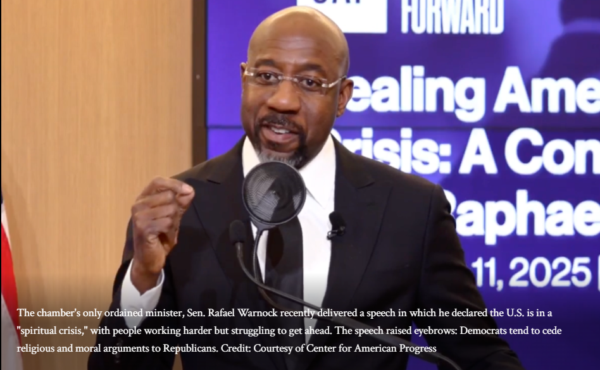

Sen. Raphael Warnock, who holds advanced degrees in theology and divinity, still preaches at Ebeneezer Baptist Church in Atlanta, the former pulpit of Dr. Martin Luther King Jr.
Among the many accomplishments on the resume of Sen. Raphael Warnock, one is particularly noteworthy. The first Black senator to represent Georgia, Warnock is the only ordained minister in the body; on Sundays in Atlanta, he preaches from the former pulpit of Dr. Martin Luther King, Jr.
So it should not have been surprising that, in a recent speech, Warnock declared that America is in the midst of a “spiritual crisis” that threatens to unravel the nation’s fundamental ideals and cripple subsequent generations.
LEARN MORE: Clergy in Philly Are Using POWER to Help the Working Class
“As policymakers, we’re writing a letter to our children about the kind of nation we want to be,” he said in a speech last week before the Center for American Progress, a left-leaning think tank. “And today, we must ensure that letter reflects hope, equity, and shared opportunity for all.”
‘A Drag on the Spirit’
He went on: “People are working harder and harder but are seeing less and less from the work they’re putting in. When you have that kind of increasing disconnect between the American promise and the lived reality of everyday people… not only is it a problem for your material well-being, I submit that it is a drag on the spirit.”
While the subject of economic inequality isn’t new, some political observers took note that Warnock framed his speech in spiritual terms — a rare move for a Democrat. Warnock, they say, may be boldly attempting to reclaim Christianity from the iron grip of conservative Republicans.
When you have that kind of increasing disconnect between the American promise and the lived reality of everyday people… not only is it a problem for your material well-being, I submit that it is a drag on the spirit.Sen. Rafael Warnock (D-Ga)
Jim Wallis, a theologian, writer, and political activist, told The Washington Post that Warnock’s use of faith to frame his speech was no accident, and the senator’s party should take notice.
“Democrats make a mistake when they concede religion to Republicans,” said Wallis, founder and former editor of Sojourners magazine. Rather than allow the right to define Christianity, he said, “…let’s have that conversation about what the teachings of Jesus were and how they relate to how we treat others.”
A Threat to the Nation
Warnock delivered the speech as part of the Center’s “What’s Next: Conversations on the Path Forward” series, which provides a platform for policymakers and scholars to discuss significant national challenges.
He called out lawmakers for failing to tackle the rising cost of living with the same urgency as moral or national security threats.
RELATED: Bishop William Barber Launches Legal Fight Over Gerrymandering
“We have become a nation where we no longer see our neighbors as crucial to our own success, but as competitors in a competition for scarce resources,” Warnock said. “Decades of this low-grade fever left untreated have brought us to where we are today — a nation in crisis.”
No one would deny his premise in light of the challenges created in the first nine months of the Trump administration: the demolition of government-backed diversity, equity, and inclusion initiatives; the demolition of the Department of Education, the 350,000 government jobs vacated, mostly harming Black women, the short-term cessation of the SNAP benefits during the government shutdown.
The Dramatic Truth
A few days before Warnock’s speech, Sen. Jon Ossoff, his fellow Georgia Democrat, criticized the Senate’s Republican majority for doing nothing to address a looming healthcare crisis. Unless President Donald Trump and his allies in Congress act quickly, Ossoff said, healthcare premiums will skyrocket out of reach for many of his constituents.
Warnock agreed with Osshoff: if that happens, people could suffer or even die for lack of health insurance.
“That’s not drama; it’s the truth,” Warnock said. Trump has the power to prevent the disaster, he said, but has chosen to focus on other things.
“What if, instead of bullying powerful corporations to build himself a ballroom, the president could push companies to pay their workers a living wage?” Warnock said. “We cannot be successful unless we reckon with the deeply uncomfortable truth that corporate interests have too much influence over both parties,”
“Too often we have the best politicians that money can buy, and this has consequences for ordinary people,” he said.