
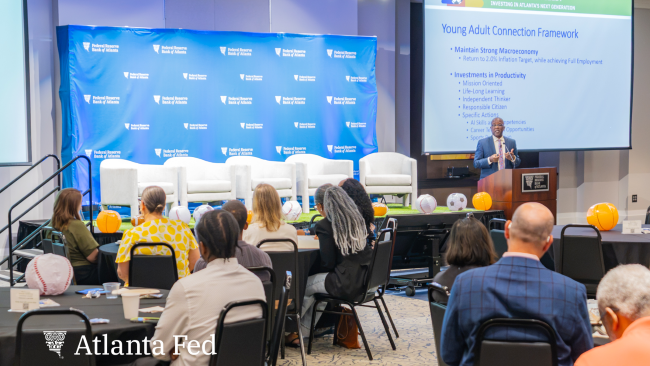

The Federal Reserve Bank of Atlanta recently brought together leaders from a variety of backgrounds to talk about how sports can help strengthen youth development and expand pathways to economic mobility.
William Rodgers, who serves as vice president and director of Community Development Research at the Federal Reserve Bank of St. Louis, moderated a panel discussion and presented a range of findings. He shared that Atlanta’s rate for young adults who are not employed or in school—also called disconnection—exceeds the US rate by more than 10 percent and has risen in recent years. Other takeaways:
- The ability of sports participation to reduce disconnection in 16- to 24-year-olds is largest among lower income families.
- Sports participation can decrease disconnection at most ages.
- Sports participation is highest in affluent households.
Sports as a tool for economic mobility
Sports-based youth development programs build social skills, time management, confidence, leadership skills, and workforce readiness. They can also help diversify educational pathways, including scholarships. Sports also builds social capital, connecting youth with mentors, sponsors, and corporations that can lead to more opportunities.
“We are providing a venue for this discussion because broadening access to youth sports is one avenue to expanding opportunity—not just to play but to learn the lifelong lessons that come with being part of a team, working toward common goals, and developing talents that in many cases kids may not realize they have,” said Cheryl Venable, the Bank’s interim president and chief executive officer and first vice president and chief operating officer. “Research tells us playing organized sports, similar to engaging in music, visual arts, or drama, is an important complement to school in helping young people develop executive functions and discover pathways to economic opportunity.”
The discussion panel featured Kaseem A. Ladipo, executive director of Soccer in the Streets; Malika Anderson, chief community impact officer at United Way of Greater Atlanta; Alexis Roe, vice president of community impact for the Atlanta Hawks , and Kelli Stewart, chief executive officer for LEAD Center For Youth.

Barriers that add up
Panelists discussed several issues they’ve seen firsthand that affect youth’s access to sports development programs.
- Financial restraints persist. Travel and equipment costs, geographic barriers, and registration fees are some of the factors that price out those who cannot afford it. In many instances, school-based programs are the only accessible option for low-income families.
- It’s not about lack of ambition. Low-income youth often experience a disconnection tied to lack of belonging, exposure to opportunities, and limited access to mentors and appropriate social networks.
- Solving for childcare is complex. Girls who aspire to play sports often face additional hurdles, including being default caregivers to younger siblings.
- Adverse childhood experiences—from poverty to drug addiction and domestic violence—create trauma that compounds into adulthood, making supportive buffers like youth development programs a key part of growth and eventual success.
- Funding models are not collaborative. Competitive grants pit organizations against one another to fight for funding that will sustain their own programs.

What can communities do?
Each panelist spoke about possible solutions to these barriers.
- Reduce financial restraints. Offer free to low-cost programming that will open doors for more families to participate. This could include support for transportation costs and food.
- Create collaboration and partnership opportunities across sectors. Schools, nonprofits, local corporations, and city agencies must coordinate efforts to meet their shared outcome. Funders need to deploy capital in ways that make collaboration feasible and effective.
- Work directly with young people to develop quality programs and solve the real-life barriers to participation that they face.
- And finally, having ideas is great, but without money, nothing happens.
The panel emphasized that investing in youth with intention and collaboration can go a long way toward helping remove barriers and create opportunities for building an economy that works for everyone.