
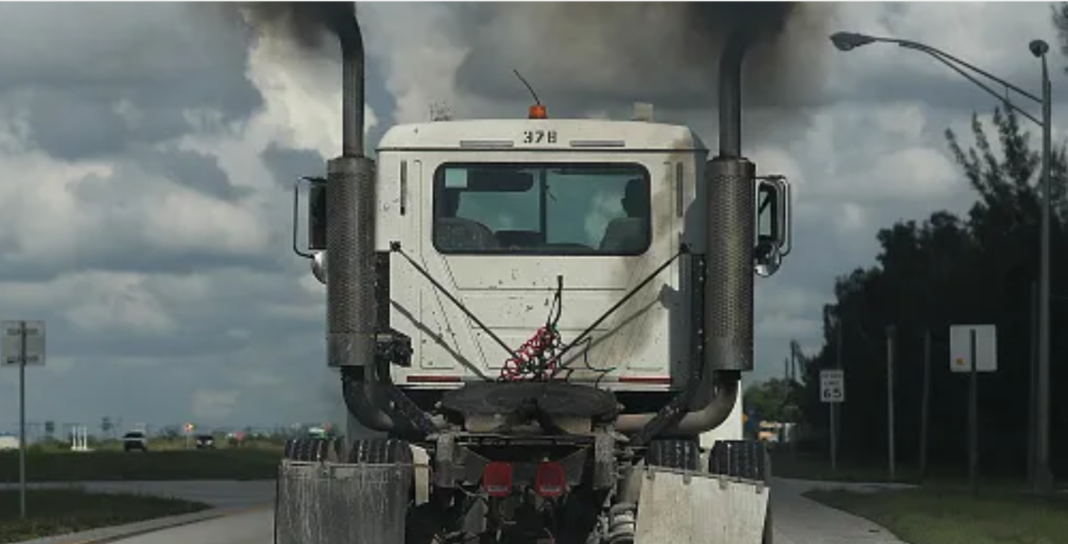

For decades, highways and industrial corridors have exposed Black communities to disproportionate levels of diesel pollution. As the Trump administration eases clean truck standards, environmental advocates warn those neighborhoods could once again pay the highest price.
The research is conclusive: Black communities are disproportionately exposed to diesel exhaust and other traffic-related pollution. So when Biden-era crackdowns on diesel emissions were scheduled to take effect, Black neighborhoods near freeways or industrial corridors anticipated breathing easier.
But a new move by the Environmental Protection Agency could mean the air in those communities could get worse, and soon.
LEARN MORE: Texas Keeps Greenlighting Pollution. Guess Who Lives Nearby
The Trump administration has announced it is pushing back or adjusting diesel emission restrictions that had been tightened under President Joe Biden, calling the regulations “unnecessary and unworkable.” Originally announced in 2023 and set to take effect this year, the regulations would have required trucks and other diesel engines to use more advanced, emissions-reducing technology.
No Data on Health
In a statement earlier this month, the EPA said the change will save truckers some $12 billion, including up to $6,152 per diesel engine subject to the regulations. American consumers and households would reap the benefits, according to the statement.
“Collectively, these savings will be passed on to American families through lower costs for food, household goods, and other products trucks deliver, while still maintaining strong environmental protections and ensuring clean air,” according to the statement.
The agency did not calculate how the changes would affect human health.
Under Biden, the E.P.A. estimated that 72 million people lived within a mile of a truck freight route, increasing their exposure to unhealthy air. The study found that Black people and those with lower incomes were more likely to live in these areas.
Semi-trucks, buses, and other heavy-duty vehicles only make up a small portion of the vehicles on American roads and highways. They are more likely to pollute the air in neighboring communities, which are often home to Black and brown people.
Semi-trucks, buses, and other heavy-duty vehicles only make up a small portion of the vehicles on American roads and highways. They are more likely to pollute the air in neighboring communities, which are often home to Black and brown people.
But because of their larger, often diesel-powered engines, heavy-duty vehicles account for a disproportionate amount of the pollution emitted by the transportation sector.
The heavy-duty fleet accounts for 45% of smog-forming nitrogen oxide emissions – pollution that the Biden Administration made efforts to curtail with so-called clean truck standards.
Environmental groups were quick to point out that the rollback would harm public health.
“Clean truck standards save lives,” Katherine García, director of the Sierra Club’s Clean Transportation for All campaign, said in a statement. “Weakening them would mean more toxic pollution in the air and more families paying the price with their health.”
Black Communities Hurt Most
There’s a substantial amount of research that shows how emissions from trucking and other heavy-duty vehicles are particularly harmful to Black families.
A Union of Concerned Scientists report from 2019 found that people of color living in the Northeast were exposed to 66% more pollution from vehicles — including a disproportionate amount emitted by a small number of heavy-duty vehicles — than white residents.
The higher levels of exposure are part of the legacy of redlining, which clustered Black households in less desirable parts of cities. That included neighborhoods developed near factories, freeways, and industrial corridors.
Environmental groups objecting to the change also noted that technological developments are making it substantially easier to cut emissions from heavy-duty fleets.
RELATED: Formaldehyde Is Everywhere. Get Ready to Breathe More of It
Peter Zalzal, associate vice president for the Environmental Defense Fund, said in a statement that diesel engines “emit huge amounts of smog- and soot-forming pollution into the air we breathe.” But vehicle manufacturers, he said, “are already introducing new engines that can substantially cut this pollution and meet protective standards.”
The EPA “should abandon this proposal and instead maintain strong pollution safeguards for new heavy-duty vehicles,” Zalzal said.