

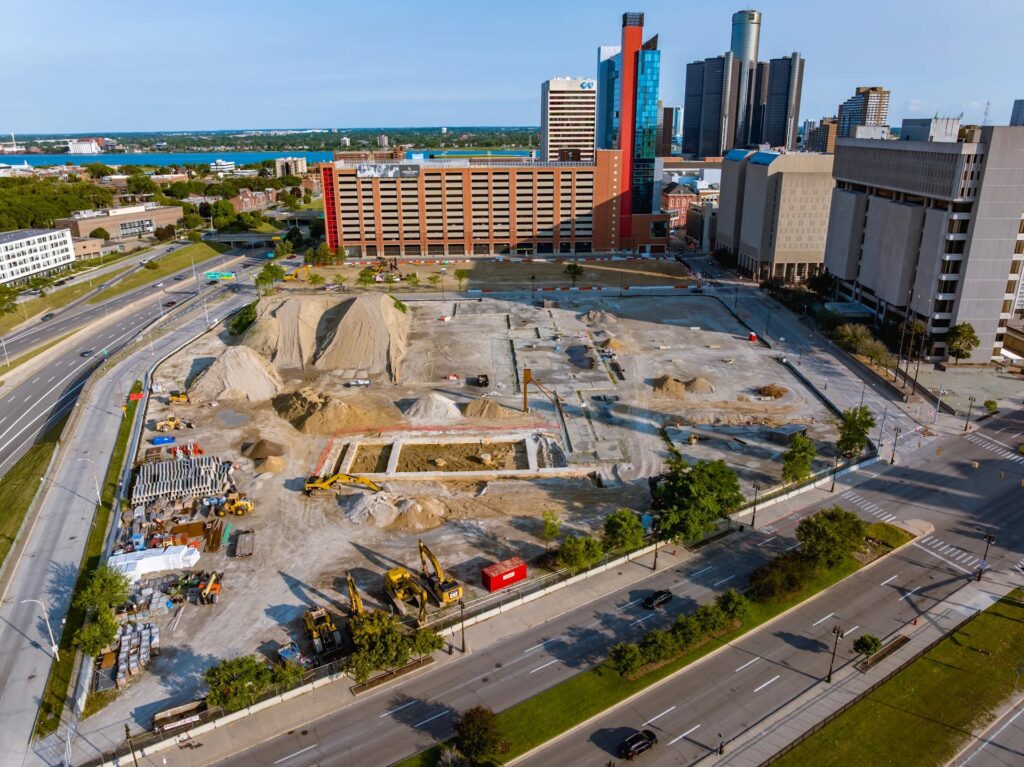
On most days, if you drive down Gratiot Avenue and pass that long-troubled stretch of land, you probably don’t slow down.
For years, there hasn’t been much to see. It’s just the lingering memory of what was supposed to be the Wayne County jail project. Instead, it became a stalled construction site, a political headache, and eventually a nickname that stuck across the city: the “fail jail.”
Detroiters know the story. A project that started with one purpose and ended up sitting half-finished, over budget, and highly visible. Not exactly the kind of landmark a city wants in the middle of downtown and as an entry point off the freeway to visitors and residents.
But on a recent afternoon, that space felt different.
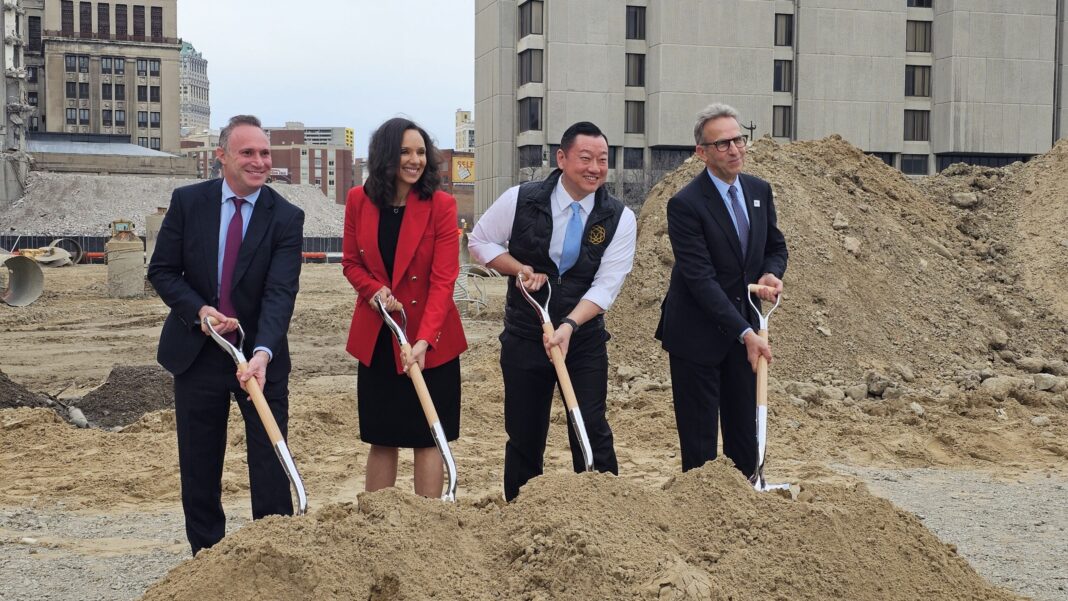
There were hard hats, shovels, a small crowd gathering, and perhaps more importantly, there was a sense that something long overdue was finally happening.

The official groundbreaking for the new Gratiot Life Sciences Building brought together developers, doctors, and city leaders, all standing on ground that, until recently, represented a very different chapter.
“This is about the future of health,” said Jared Fleisher, CEO of Bedrock. Then he paused for a second, like he wanted that part to land. “And it’s about the future of our economy.”
That dual message came up again and again throughout the brief ceremonial groundbreaking for the new facility. Because while this is a construction project, it’s also something bigger for Detroit; something that’s being pitched as a shift in how the city positions itself, especially when it comes to healthcare and life sciences.
And to understand that, you have to understand what’s actually going inside this building. The anchor is BAMF Health, a company that’s been quietly building a name in precision medicine. If you’ve never heard of theranostics, you’re not alone. It’s one of those terms that sounds complicated until someone breaks it down.
Fleisher tried to do exactly that.
Most people are familiar with chemotherapy, he said – the kind of treatment that goes after cancer but can also take a toll on the rest of the body. Theranostics flips that idea. Instead of being broad and aggressive, it’s targeted. It looks for specific markers on cancer cells and delivers treatment directly to them.
More precise. Less guesswork.
That’s the vision that Dr. Anthony Chang has been chasing for more than a decade.
Before starting BAMF, Chang was a physician and researcher. He saw the potential of this kind of technology early on, but also saw how slow the system was to adopt it.
“At conferences, people kept saying, ‘This is the future,’” Chang said. “And then 10 years later, it was still the future.”
Meanwhile, patients were waiting.
That disconnect is what pushed him to start the company in the first place. And if you listen to him talk, there’s still a little frustration there mixed with this sense of urgency. The kind that doesn’t really leave once you’ve seen what’s at stake.
BAMF’s first major facility opened in Grand Rapids a few years ago. This Detroit location will be its second, and in some ways, its most important. Not just because of size or scope, but because of where it sits.
Detroit carries weight.
“A hundred years ago, this city changed how the world moves,” Chang said. “Now we have a chance to change how diseases are treated.”
That might sound lofty, but the partnership behind this project suggests people are taking it seriously.
Along with Bedrock and BAMF, Henry Ford Health is a key player, and that’s something Dr. Adnan Munkarah made clear when he stepped up to the podium.
If you’ve spent any time around Henry Ford’s leadership, you’ve heard the word “partnership” before, and the health system doesn’t treat that as a buzzword.
“This is a defining moment,” Munkarah said, speaking not just as an executive but as a cancer specialist. “For healthcare, for our system, and for Detroit.”
He talked about how far precision medicine has come and how much further it needs to go. The idea is simple: “Treatment that’s tailored to the individual, not just the disease,” he said. But getting there takes infrastructure, research, and access. A lot of access.
And that’s where Detroit comes in.
Because for all the innovation happening in medicine, not every community benefits equally. Munkarah touched on that directly.
“Where you live should never determine the quality of care you receive,” he said.
It’s the kind of line that sounds good in a speech, but it hits a little closer to home in a city like Detroit where roughly 1 in 10 Detroiters lack healthcare, 1 in 3 residents feel like they don’t get the quality of care they deserve, and 3 in 5 live in medically underserved areas.
Mayor Mary Sheffield picked up on that thread, and said this facility in this location will help close a gap in quality healthcare for residents and people in surrounding states seeking world-class care.
“For far too long, this site has sat vacant,” she said. “And for years, Detroiters have imagined what it could be.”
Now, she said, that vision is starting to take shape.
She also zoomed out a bit, pointing to the bigger picture. Detroit is building something like a network. Recent research investments tied to Michigan State University, new facilities connected to Wayne State University, and specialized institutes focused on everything from cancer to neurological diseases.
Piece by piece, it adds up.
Projects like the Gratiot Life Sciences Building are part of a broader push to make Detroit a real player in health innovation.
Of course, none of this happens without money. And in this case, a big part of the financial backing comes from Dan Gilbert, founder of Bedrock, who took a special interest in making Detroit a hub for healthcare after facing a near-death experience himself not too long ago.
Fleisher gave him a quiet but pointed nod during his remarks. Because taking down a partially built jail – one that already cost millions – isn’t exactly a routine development decision. But it was necessary.
Instead of letting the site sit or trying to force it into its original purpose, Gilbert and his team chose a conceptual restart. And the restart was less about containment and more about care and filling the hole – and the needs of the people.
When it’s finished in 2027, the building will include a 45,000-square-foot ground-level facility dedicated to theranostics, along with additional office and lab space above. There’s talk of about 90 new jobs, though people at the event seemed more focused on what those jobs represent than the number itself.
Opportunity. Access. A different kind of growth.
Still, for a lot of folks standing there, the biggest takeaway wasn’t in the renderings or the stats or even in the billion-dollar corporations whose names were tied to it.
The biggest takeaway was that a place that once symbolized a project gone wrong – a project that would have been a symbol of the bad people in society, including people who take lives – is getting another shot and this time tied to something that could actually change lives. And this will be all about saving lives.